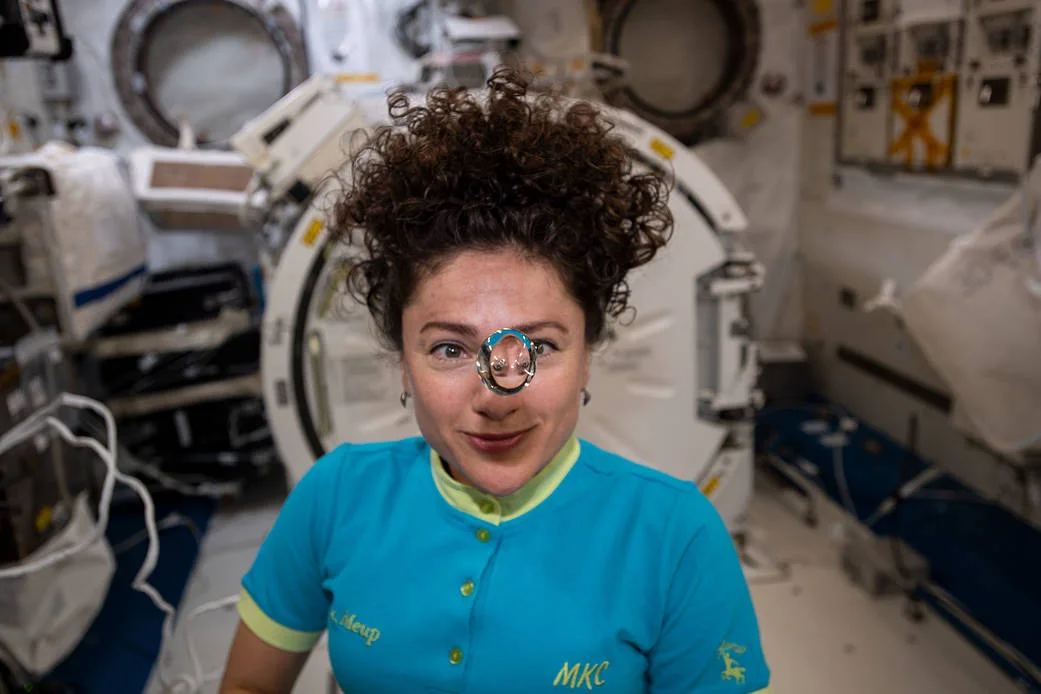
The balance of forces changes
Fluids respond to several forces at once: gravity, inertia, viscosity, pressure, and surface tension among them. Lowering gravity does not turn the other forces off. It changes their relative importance.
NASA describes low gravity as a setting in which researchers can observe and control transport phenomena that gravity masks on Earth. In microgravity, buoyancy-driven convection and sedimentation are greatly reduced, while surface-tension and interfacial effects can become dominant (NASA Fluid Physics; NASA, Benefits of Microgravity).
A useful dimensionless comparison is the Bond number:
Bo = Δρ g L² / γ
where Δρ is the density difference, g is gravitational acceleration, L is a characteristic length, and γ is surface tension. A lower Bond number means surface tension matters more relative to gravity. The number does not describe a complete device by itself; it shows which forces are most important.
Buoyancy and convection weaken
On Earth, density differences can move fluids: warmer or lighter fluid tends to rise while cooler or denser fluid tends to sink. That buoyancy-driven motion can transport heat, mix materials, and move gas bubbles toward a free surface.
When effective gravity is small, the buoyant force is small too. Heat and mass transport may rely more heavily on diffusion, forced flow, capillary effects, or deliberately imposed acceleration. Hardware that passively vents a bubble on Earth may no longer do so in orbit.
The precise outcome depends on geometry, wetting, temperature, acceleration disturbances, and operating history. “No buoyancy” should therefore be treated as a limiting approximation, not a universal description of every spacecraft condition.
Sedimentation and phase separation change
Particles and droplets settle on Earth when gravitational forces overcome resisting forces. In microgravity, sedimentation is reduced, so dispersed materials may remain suspended longer. NASA’s Soft Matter program uses that reduction to examine interactions that Earth gravity can obscure.
Gas-liquid separation also becomes a design problem. Gravity no longer provides a reliable “up” direction for gas and a “down” direction for liquid. Interfaces can be set by container geometry, surface treatment, capillary structures, pressure differences, and residual accelerations. This matters for storage, thermal control, life-support fluids, sample handling, and propellant management.
Capillary effects become design tools
Capillary flow is driven by surface tension and wetting. NASA’s Capillary Flow Experiment studied contact-line dynamics, interior-corner flows, and wetting in geometries where idealized boundary conditions were not sufficient.
The lesson is not that capillarity solves every low-gravity fluid problem. It is that walls, corners, vanes, screens, contact angles, and fill fraction can become primary parts of the fluid-control system. Small geometric changes may redirect liquid, trap gas, or change the stability of an interface.
Earth, Moon, Mars, and orbit are distinct
The Moon’s surface gravity is about one-sixth of Earth’s (NASA Moon Facts). Mars is about 38 percent of Earth gravity (NASA JPL, Mars at a Glance). Orbiting laboratories experience microgravity rather than exactly zero gravity.
These environments should not be collapsed into one “space” setting. The dominant forces can change with gravity level, hardware size, material, and geometry.
How Ground Blue would model the problem
A passive fluid cartridge is a practical first model for Ground Blue. The calculation begins with defined geometry, fluid properties, contact behavior, initial fill state, gravity level, and a measurable output such as interface location or arrival time.
Published experiment records can then test how well the calculation works across different geometries and fluid conditions. The conceptual cartridge diagrams on this site show the planned workflow; they are not hardware performance results.
Sources
- NASA, Fluid Physics.
- NASA, The Benefits of Microgravity.
- NASA, Soft Matter.
- NASA PSI, Capillary Flow Experiment | PSI-38.
- NASA, A Researcher’s Guide to Fluid Physics.
- NASA, Moon Facts.
- NASA JPL, Mars at a Glance.